
Stronger Together: Breathing, Bracing & the Pelvic Floor
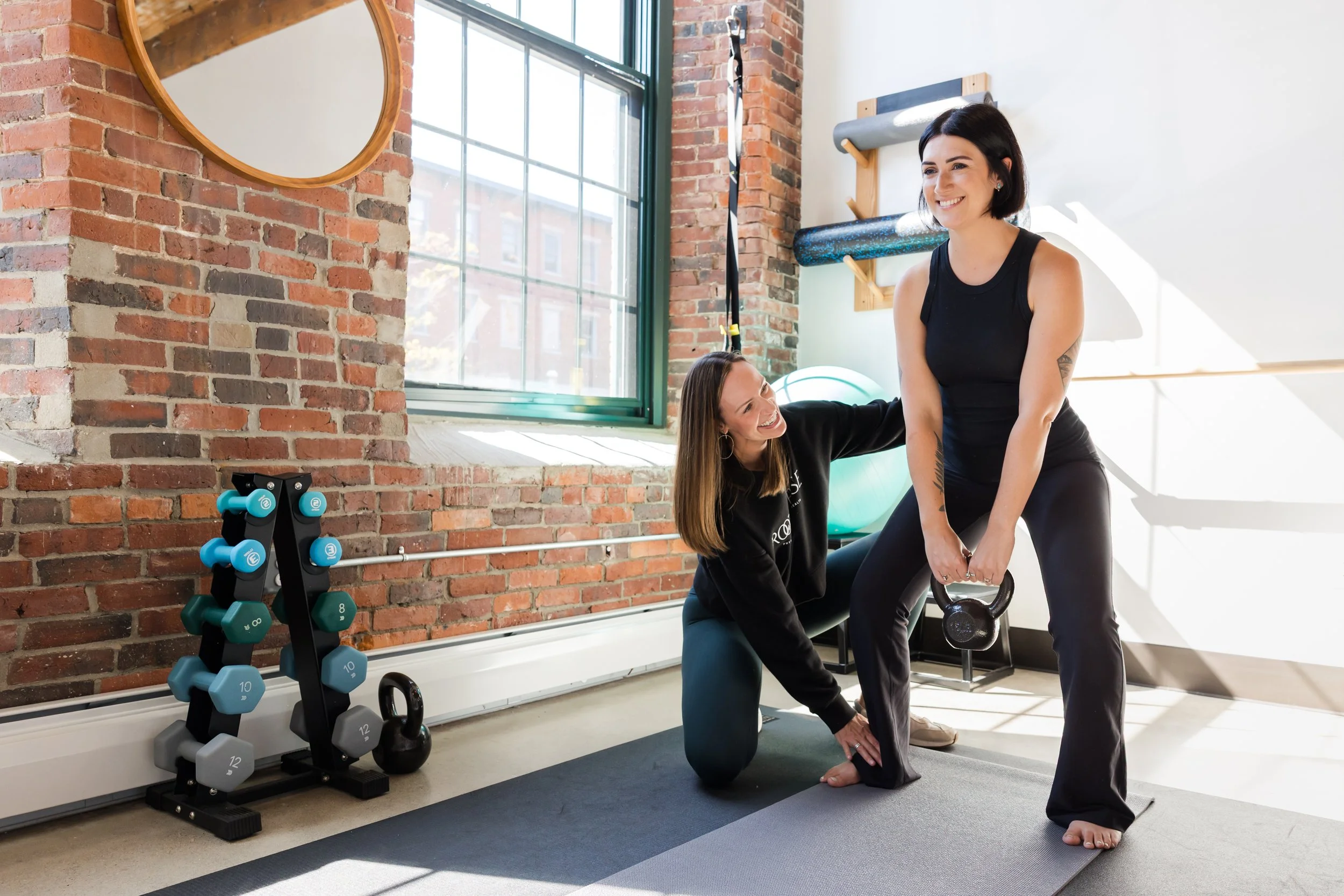
Dr. Jenn Gelfand, Pelvic floor PT, instructing a patient in breathing techniques for lifting at Root To Rise Physical Therapy & Pelvic Health in Scarborough, Maine.
Our team recently spent time at Iron Legion in Scarborough, Maine, with Andrew and his team of personal trainers. It was a chance to compare notes on something we all care about: helping people lift heavier while staying strong, connected to their core, and symptom free.
We talked about how each of us guides patients and clients to connect with their core, and how we navigate the nuances of training for both pelvic floor health and overall, sustainable strength. A big part of the conversation focused on breathing, and specifically when (and how) to use a breath hold (the Valsalva maneuver) and when to use a more functional breath pattern.
Breathe to match the load
We all agreed on one key idea: a breath hold is a tool, not a rule for every rep.
When you're lifting heavy, roughly 80% or more of your one-rep max, a brief, braced breath hold helps keep your spine stable. Andrew's team walked us through proper bracing for those heavier lifts, and our team loved learning the details firsthand.
Below those heavier thresholds, we want clients using functional breath patterns instead. Think of it as a dial:
Exhale on effort for warm-ups, light to moderate weights and higher reps.
A hiss or grunt (letting air out through a partly closed mouth or throat) for moderately heavy sets.
A brief breath hold through the sticking point for heavy squats, deadlifts and presses, then exhale once you're past it.
Research also does back this up. A breath hold raises pressure in the abdomen more than other breathing strategies, which supports the trunk under heavy loads. Strength and conditioning guidelines recommend exhaling through the hardest part of the lift as the default, and saving a short breath hold for heavy, spine-loading exercises.
The key here is that your pelvic floor and deep core muscles have to be able to manage this pressure in the abdomen well in order to avoid excessive pressure downward on the pelvic floor.
Connection breath: the warm-up before heavy lifting
The trainers asked so many great questions about how to cue and teach the subtleties of a deep core "connection breath." We use it as a warm-up and a precursor to heavier lifting.
The idea is simple: as you inhale, your diaphragm and pelvic floor gently lower and lengthen.. As you exhale, they rise and gather tone together with your deep abdominals. Practicing this before you load the bar helps you find that connection, so your bracing for heavier lifts is coordinated rather than just forceful. We also talked about how tempting it can be to skip this step. It's subtle and doesn't feel like "work.” but building this coordination is what makes lifting heavy loads sustainable over the long run.
Listening to symptoms
We also talked about how to start conversations with clients about pelvic floor symptoms. Signs that a lift, a load or a breathing strategy needs adjusting include:
Leaking urine, gas or stool
Urinary or bowel urgency or frequency
Heaviness, pressure or bulging in the vagina or rectum
New or flared hemorrhoids
Pelvic, low back or abdominal pain
Doming or bulging along the midline of the abdomen
These symptoms are common in people who lift, but they're not something you just have to live with. They don't mean you need to stop lifting, either. They're a signal to adjust, and a good reason to see a pelvic floor physical therapist.
Better together
Our collaboration with Iron Legion has been incredible over the years, and this visit filled our hearts. Trainers and pelvic floor PTs each bring something different. When we learn from each other and work together, our clients and patients get the best of both: coaching to get stronger, and support to stay symptom free along the way.
That's the goal we share: helping our community get and stay symptom free, and stronger than ever.
Lifting and noticing symptoms? Talk with your trainer, and reach out to us. At Root To Rise Physical Therapy & Pelvic Health, we offer whole-body pelvic floor care in Scarborough and Bath, Maine, and virtually across Maine. We're happy to work alongside your trainer to keep you lifting.
If you’re local to Scarborough, Maine and looking for a place to build strength with caring and compassionate trainers, check out Iron Legion Strength Co. You won’t regret it.
References
Hackett DA, Chow CM. The Valsalva maneuver: its effect on intra-abdominal pressure and safety issues during resistance exercise. J Strength Cond Res. 2013;27(8):2338–2345.
National Strength and Conditioning Association. Essentials of Strength Training and Conditioning, exercise technique chapter: breathing considerations.
Influence of powerlifting and weightlifting on female pelvic floor dysfunction: systematic literature review. Int Urogynecol J. 2025.